




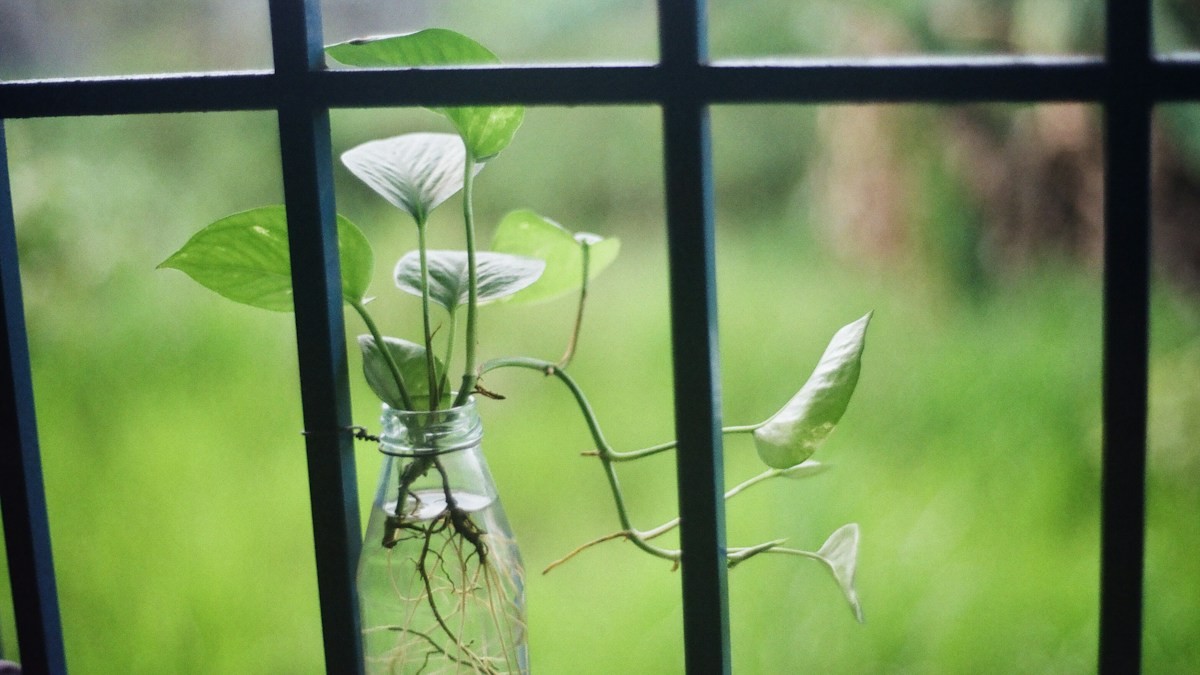
The Golden Pothos (*Epipremnum aureum*) is undeniably the most ubiquitous houseplant on Earth. Adorning bookshelves, desktop cubicles, coffee tables, and macramé plant hangers in millions of homes worldwide, its cheerful heart-shaped leaves and legendary resilience have made it the quintessential starter plant for generations of indoor gardeners. However, in nearly every home where it is grown in a hanging basket or allowed to trail downward from a high shelf, a peculiar and frustrating phenomenon occurs over time: as the trailing vines grow longer, the newest leaves do not get bigger—they shrink into tiny, fragile discs rarely larger than a coin.
Meanwhile, photographs of wild pothos vines thriving on tropical islands like Hawaii or southern Florida reveal an astonishingly different botanical reality: monumental, tropical climbing lianas with colossal leaves stretching two feet wide, thick structural petioles, and dramatic natural splits reminiscent of a giant *Monstera deliciosa*. Many plant enthusiasts assume these wild specimens are an entirely different exotic cultivar, but genetically, they are identical to the humble trailing houseplant sitting on your desk.
The difference between a spindly hanging vine and a colossal tropical monster is entirely dictated by orientation and mechanical support. This master botanical guide investigates pothos leaf sizing moss pole dynamics. We explore the hormonal physics of negative geotropism, demonstrate how sphagnum moss poles unlock adult vegetative phenotypes, and provide a clear step-by-step protocol to transform miniature trailing vines into giant architectural foliage.
The Plant Physiology of Climbing: Why Trailing Vines Shrink
Understanding the gravitational and hormonal physics of hanging baskets.
Vascular Hydrodynamics and Gravitational Resistance
In wild tropical rainforests, *Epipremnum aureum* is an aggressive hemiepiphytic climber that uses giant tree trunks as ladders to reach the illuminated upper forest canopy. When grown in a domestic hanging basket, the plant is forced into an unnatural downward trajectory.
As vines cascade three to six feet below the rim of the pot, internal plant hydraulics must pump water and vital dissolved minerals against the natural direction of sap flow. Combined with diminished light levels beneath the pot canopy, the plant enters an energy-saving survival mode, progressively reducing leaf lamina surface area to conserve metabolic reserves.
Auxin Redistribution and Apical Dominance Suppression
Plant morphology is heavily governed by auxins—plant hormones synthesized in the growing shoot apex that direct cell elongation and vascular differentiation. In an upright climbing vine, auxins flow smoothly basipetally (downward toward the roots), reinforcing apical dominance and signaling that structural conditions are ideal for producing larger leaves.
When a vine hangs downward, gravity causes auxins to pool irregularly, disrupting the hormonal communication between the shoot tip and the root ball. Consequently, the vine produces elongated internodes with stunted, miniaturized leaves, desperately seeking an upward vertical anchor that never arrives.
Building and Maintaining the Ultimate Sphagnum Moss Pole
Transforming aerial roots into fully functional vertical feeder channels.
Sphagnum Moss vs Coir Coco Stakes
Many commercial plant poles consist of dry coco coir wrapped tightly around a wooden dowel or PVC pipe. While these provide rigid physical support, coco coir is hydrophobic and virtually incapable of holding sufficient ambient moisture to sustain aerial root penetration.
A true functional moss pole is constructed from galvanized or plastic wire mesh cylinders packed tightly with high-grade, long-fiber New Zealand sphagnum moss. Sphagnum moss acts as an enormous vertical water reservoir, absorbing up to twenty times its dry weight in water and creating an irresistible microclimate for climbing roots.
Hydration Protocols: Keeping the Moss Core Consistently Damp
For a moss pole to trigger giant leaf sizing, the sphagnum core must never be permitted to dry into a crisp, hydrophobic sponge. Light surface misting with a hand spray bottle evaporates within an hour and fails to penetrate the interior core where root tips reside.
The professional technique involves inverted drip-irrigation: invert a small plastic water bottle with a pinhole in the cap directly into the top opening of the wire pole once or twice weekly. Water slowly trickles through the entire vertical column, saturating the moss fibers without flooding the bottom soil container.

Step-by-Step Training: From Hanging Vine to Giant Climber
The surgical potting and anchoring protocol for explosive leaf expansion.
Securing Nodes Firmly Against Damp Moss
When mounting an established pothos onto a moss pole, position the main vine so that each stem node presses firmly against the damp moss surface. Fasten the stem securely using soft horticultural velcro plant ties or green garden tape directly above each node.
Never wrap wire or tight string that can constrict or cut into the expanding vine stem. Within ten to fourteen days, the small brown nubs on the back of each node will swell, turn white or pale green, and actively drill deep into the moist sphagnum mesh.
Nutrient Delivery Directly Through the Pole
Because climbing aerial roots rapidly convert into active feeder roots within the moss pole, the pole itself becomes a second root system. Take advantage of this by adding a diluted balanced liquid houseplant fertilizer (such as 10-10-10 or 3-1-2 NPK) at quarter-strength into the water used to hydrate the moss pole.
Delivering nitrogen and micronutrients directly to the climbing nodes bypasses the distance from the bottom pot, supercharging cellular division in emerging leaf petioles. Within 4 to 5 successive leaf nodes on the pole, you will observe leaf diameter expanding from 3 inches to 8, 12, and eventually 16+ inches.
Pothos Growing Systems Comparison: Hanging Basket vs Moss Pole
| Architectural Parameter | Trailing Hanging Basket | Coco Coir Stake | Damp Sphagnum Moss Pole |
|---|---|---|---|
| Maximum Leaf Diameter | 2 to 3.5 inches (Shrinks over time) | 4 to 6 inches (Moderate size) | 12 to 24 inches (Giant foliage) |
| Natural Fenestrations (Splits) | Impossible (0% occurrence) | Extremely Rare (< 2%) | Common at node 8+ (Mature pheno) |
| Vascular Root Hydraulics | Single bottom root ball only | Minimal root anchoring | Dual root system (Soil + Pole) |
| Internode Spacing | Stretched & leggy (3-5 inches) | Standard (2-3 inches) | Compact & stout (1-1.5 inches) |
| Maintenance Commitment | Low (Water once weekly) | Low (Occasional staking) | Moderate (Keep pole damp) |
Recommended Further Reading & Authoritative References
To deepen your practical mastery of these concepts, explore our comprehensive analyses on managing monstera deliciosa aerial roots on moss poles and formulating chunky well draining aroid soil mix. For official technical standards, peer-reviewed benchmarks, and industry guidelines, consult the NC State Extension: Epipremnum aureum Plant Profile.
Frequently Asked Questions
Can any pothos variety grow giant leaves on a moss pole?
Yes! All cultivars of Epipremnum aureum—including Golden Pothos, Marble Queen, Neon, and Snow Queen—share the genetic capability to develop giant leaves with natural splits when climbed up a damp moss pole under high light.
Why are the leaves at the bottom of my moss pole still small?
Existing juvenile leaves never expand retroactively. Leaf sizing occurs incrementally in each new leaf produced along the upward climbing stem as the aerial roots establish deeper hydraulic connections in the pole.
How much light is required to get giant pothos leaves with splits?
Climbing alone is not enough; the plant requires abundant bright indirect light (1,500 to 2,500 lux, or a DLI of 8 to 12 mol/m²/day) to photosynthesize enough sugar to support giant mature leaves.
What happens if the moss pole dries out completely?
If the pole remains bone-dry for weeks, the aerial roots inside will desiccate and die. The plant will survive via its subterranean pot roots, but new emerging leaves will immediately stop expanding and regress to smaller sizes.